
HOW DOES IT WORK?
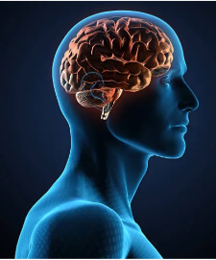
Our brains need approximately 4.5 hours of
stimulation/electricity per day to function.
80% of that stimulation is via the ears.
The ears never stop working…

…unlike the eyes.
Our body works with left and right sides of the body and ears to make sense of the sounds that come to us. Ideally, we can:
Make sense of even the quietest of sounds (very important for musicians).
Tell the direction of sound and whether it is moving. (Opera singers etc).
Understand every syllable of speech and language.
Sense a person’s emotions from the tone of their speech (Actors).
Learn foreign languages.
Remember what someone has said.
Hear speech in noisy environments and be able to block out irrelevant sounds.
Respond rapidly to auditory warnings.
Sing in tune*.
*Being in-tune is also important for group safety. A person who is anxious can cause the whole group to be anxious and sing out of tune.
The brain rejects processing of certain types of sounds because they are associated with something that is emotionally negative for people, hence the close proximity between listening and emotion, even at the level of the brain.
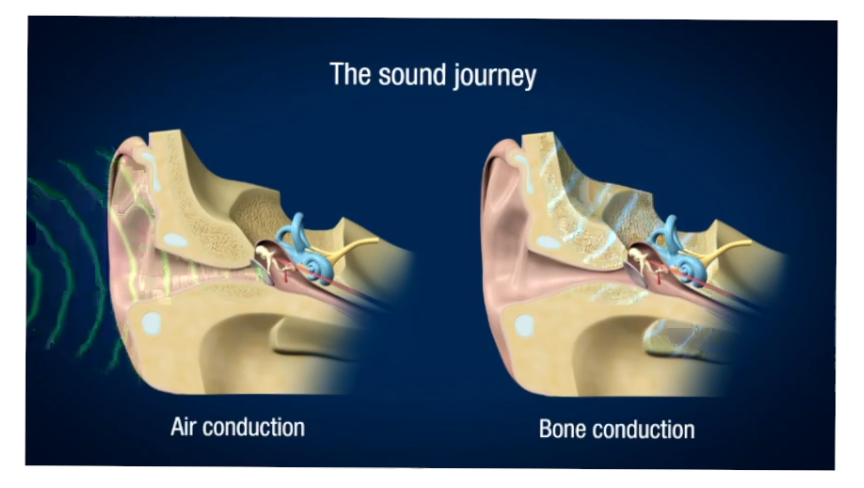
Undertstanding Air Conduction and Bone Conduction
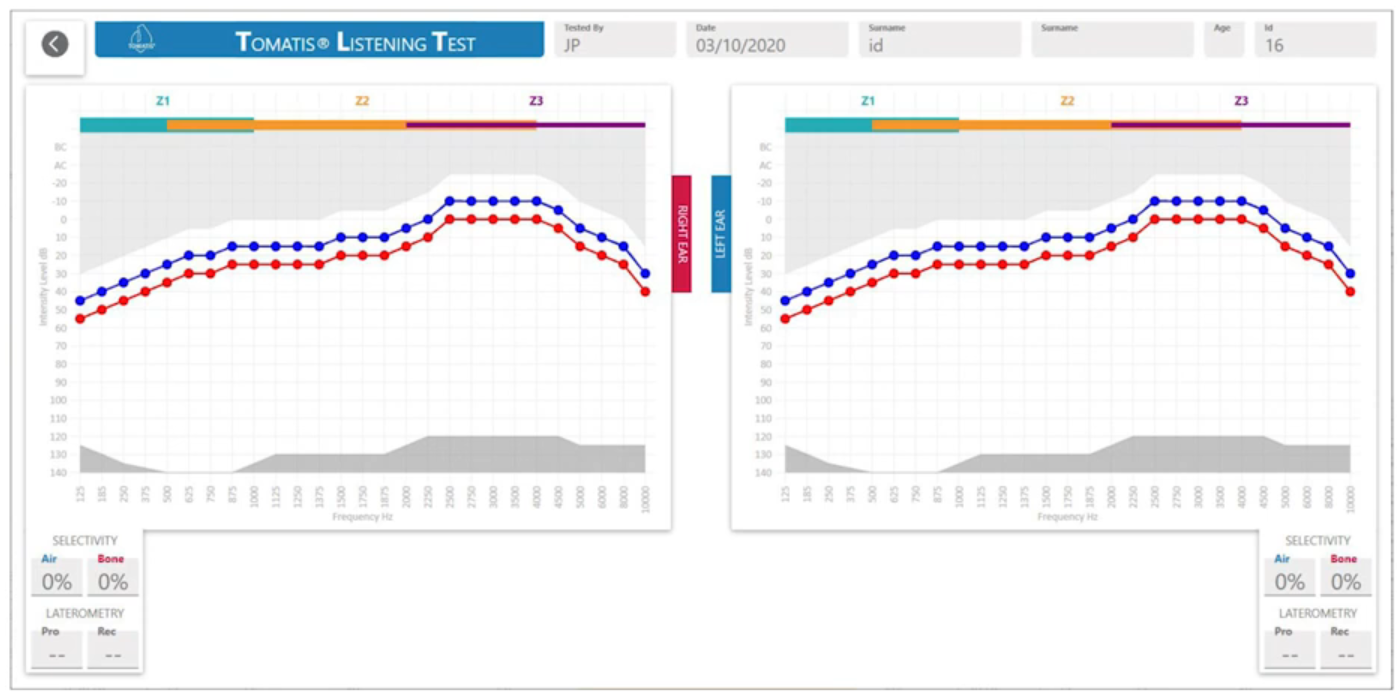
IDEAL LISTENING CURVE
(No one has this curve!)
BLUE CURVE = AIR CONDUCTION (SOUND THROUGH AIR) AC
RED CURVE = BONE CONDUCTION (SOUND THROUGH BONE) BC
Sound travels 10 x faster by bone than by air.
Bone is used in the Tomatis Method® as a prime system e.g., “Watch out, something is coming”, whereas Air conduction = “Who/What?”.
Bone conduction plays a big part in the perception of our own voices. For example, place your hands so that they are covering your ears and say out aloud: “Monday, Tuesday, Wednesday”. The sound you are hearing is through bone conduction only, as your hands are prohibiting the passage of air conduction. That is why when you first heard your recorded voice you said: “Is that really my voice”? That is because you are hearing only air conduction.
We use Air Conduction (AC), our adaptive medium (we are not fish anymore!).
Every time we receive information from the outside it is through the air – air is vibrating, touching your eardrum, and is then transmitted to the brain.
But there is another way, more archaic, much less precise, this is Bone Conduction (BC).
Examples of Listening Tests and their meaning
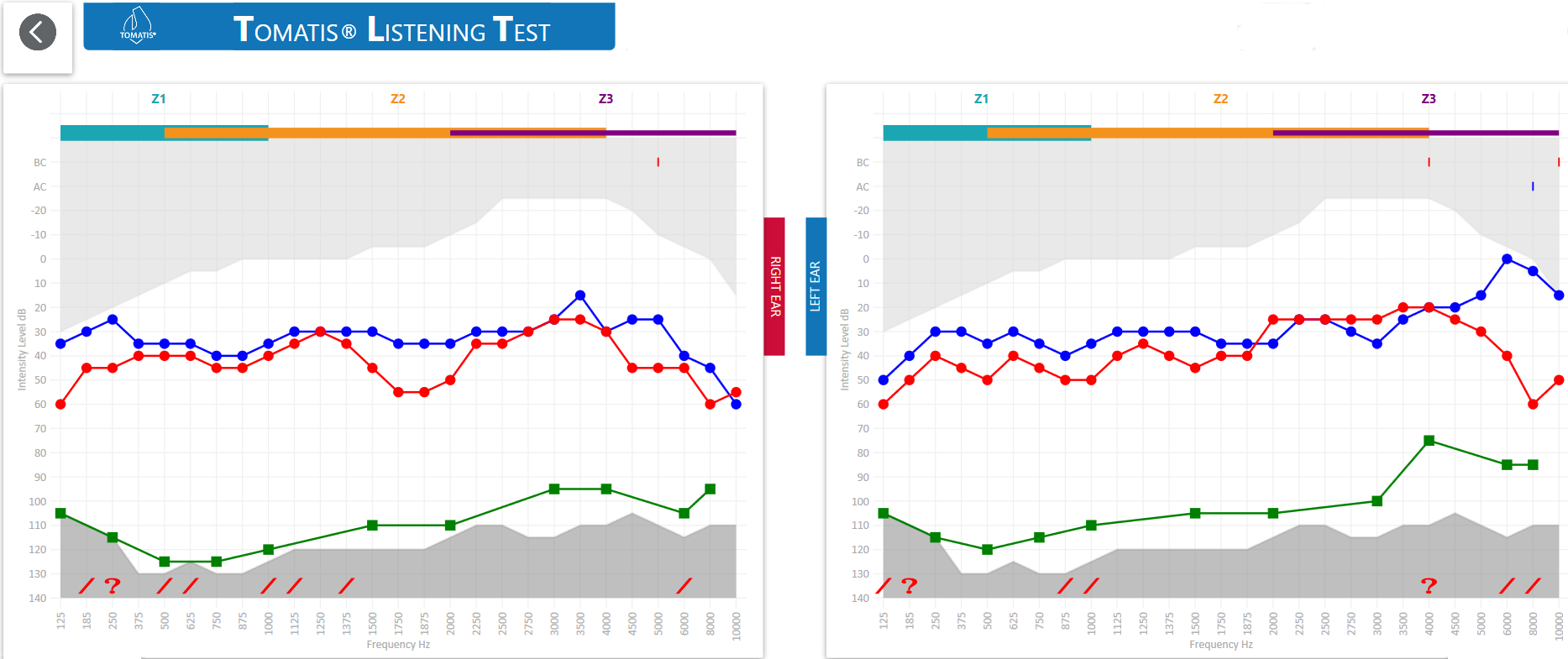
Divorce
For this singer, the problems will affect their singing voice. “The voice can only reproduce what the ear can hear” plays out here. I have noticed that even the greatest voices will be affected in their profession by divorce, often, not returning to their best of previous years.
The Tomatis Method® may help to gently re-open listening in a safe manner, without disturbing the nervous system and ultimately support a return to the world of singing.
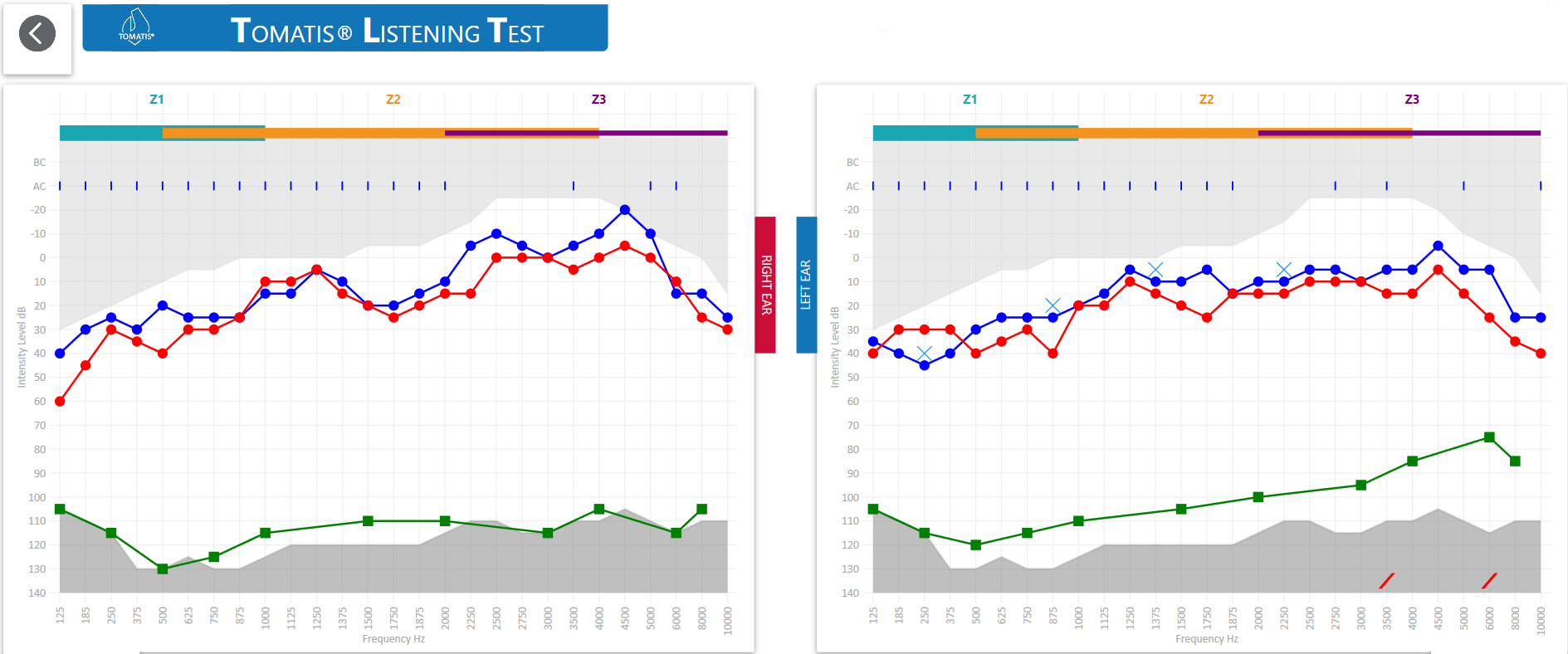
Teenager before Tomatis® Training
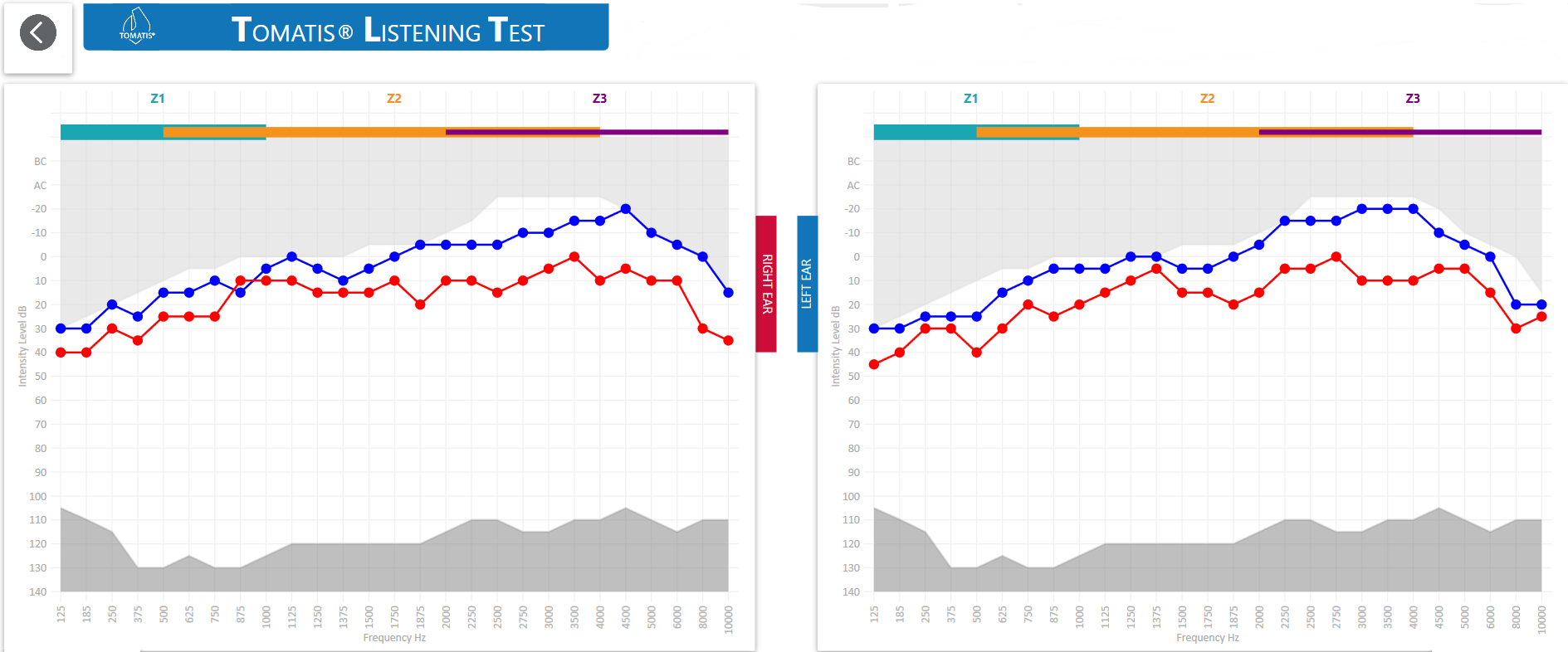
Teenager after Tomatis® Training
Compare this listening test to the one above (Ideal listening Curve).
The blue AC curve should always be above the red BC curve. Think of the AC as your skin, and BC as your bones. If the BC is higher than the AC, it is as if your bone is showing through your skin - painful!
Here, we have a 50 year old singer who was going through a dreadful divorce. The listening test curves are almost flat, as if the person is saying: “I can no longer listen to that, I am overwhelmed!”, and the trauma causes them to close down their listening to the outside world, literally.
It is a way of self-preservation, and only with this withdrawal into herself at this time, can she feel safe. It is just too painful.
This is a listening test of a teenager.
Although he has lived in the UK since birth, his English is poor. He was:
highly intelligent,
socially impulsive,
a late talker,
clumsy,
nervous,
often says: “Huh?”,
has to have directions repeated,
tires easily,
irritable and anxious, easily distracted,
difficulty in completing tasks.
After completing 2 intensives of Tomatis® Training, the listening test now shows a much more balanced curve.
He now:
Is able to speak English much better,
is not so impulsive,
is able to concentrate on his work,
has much more energy,
is much more mindful to the people around him.
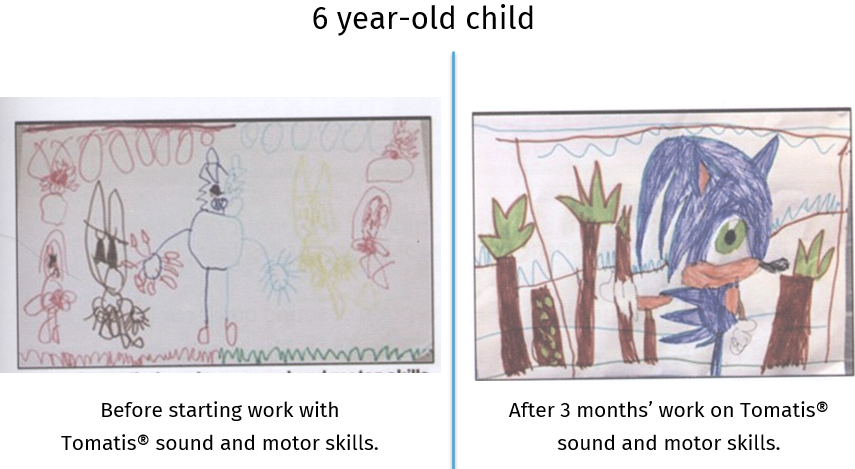
During the Tomatis® Listening sessions, Clients are encouraged to participate in anything that is not stressed related, and one of these is to draw while listening.
Here is an example of a 6-year child before and after Tomatis® training.
The picture on the left hand side is scribbled, with no relationship between the images drawn. The child struggled with visual and motor skills.
The picture on the right hand side shows that the child has advanced in global development. The whole picture now tells a story, and thought has been given to colours, ratios and balance.
This often occurs during the Tomatis training, that if Clients draw, their creativity is enhanced.
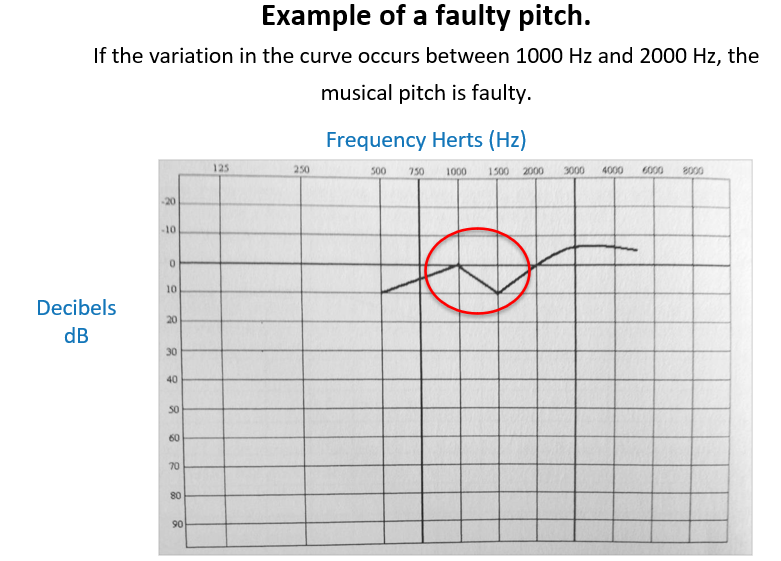
Here is an example of a musician with faulty pitch.
Have you, during a concert heard, for example, a solo violinist playing beautifully, and then suddenly, there are a few notes where they are out of tune, and then they continue to play beautifully?
These are DIPS in their listening curve. There are frequencies where the violinist is not able to hear these specific frequencies, and so they can play out of tune, just in those frequencies.